
TL;DR:
69% of professionals feel social stigma around using AI at work—so they hide it
"AI creepers" exist because of unclear policies, fear of judgment, and lack of approved alternatives
When your top performers use AI in the shadows, your organization loses the ability to learn and grow
Building AI-encouraging workplaces requires clear guidance, sanctioned tools, and leadership that stops punishing resourcefulness
“There will be two types of companies in the future. Those that are great at AI, and those that used to be in business” - Mark Cuban
Right now, one of your top performers is minimizing a browser window because someone just walked by their desk. They're not watching Netflix or scrolling social media. They're using AI to do their job better, faster, and smarter than anyone else on their team.
And they'll never tell you about it.
They are an "AI creeper" the employee who is quietly outperforming everyone around them while pretending they're doing it the old-fashioned way.
A recent survey by AI company Anthropic found that while 86% of professionals say AI saves them time and 65% are satisfied with its role in their work, 69% mentioned the social stigma that comes with using it in the workplace.
Meet the "AI Creeper"—Your Most Productive Employees
What is an "AI creeper"? (You probably have several on your team)
An "AI creeper" is someone who uses AI tools regularly for work but keeps it secret from their peers and managers. They minimize browser windows when someone walks by. They use AI on personal devices instead of work laptops. They credit their output to ‘research’ or ‘brainstorming’ without mentioning the tool that actually produced it.
According to a recent survey by Anthropic of 1,250 professionals:
86% say AI saves them time
65% are satisfied with the role it plays in their work
But 69% feel social stigma about using it
The disconnect is stark: employees love the tool but fear judgment. They're producing better and faster work; they just don't want anyone to know they're using AI.
The Confessions You're Not Hearing
Employees staying quiet about their best work
In the Anthropic study, employees shared anonymous confessions about their AI usage. Of the 125 creative professionals surveyed, 97% said AI saved them time and 68% said it increased the quality of their work. But 70% mentioned peer judgment around AI use.
For creatives, the fear isn't just about breaking rules. If AI helped you write the headline, design the layout, or structure the narrative, did you really do it? The anxiety is real, and it's keeping talented people silent about the tools that make them more effective.
Nearly every creative professional surveyed finds AI helpful. More than two-thirds say it makes their work better. But they won't admit it because they're afraid of what their peers will think.
The irony: They're producing your best work—the campaigns that perform, the designs that convert, the copy that resonates—while pretending they're not using the tool that's making it all possible.
The productivity boost no one's talking about (but everyone's using)
While leadership debates AI policy in conference rooms, their teams have already decided. They're not waiting for permission, guidance, or a formal rollout. They're using ChatGPT, Claude, or whichever tool works best, and they're using it to get ahead.
They chose speed over permission. Results over approval. And because you haven't given them clear guidance or secure alternatives, they chose secrecy over transparency.
What This Secrecy Is Really Telling You About Your Company
When your best employees feel they need to hide how they work, that's not an AI problem. That's a culture problem.
Unclear company policies create anxiety
Either companies have communicated a simplistic policy about AI, or in many cases, they have none at all. Pretending the problem will go away is not a solution, nor is dictating a policy that is too risk-averse to gain most of the benefits.
In the absence of clarity, employees default to silence. They assume it's safer to stay quiet than to ask permission. Better to keep it hidden than to risk being told "no" or being flagged as someone who "needs AI to do their job."
When leadership is silent on AI, employees fill the void with anxiety. Despite seeing the benefits for themselves, employees worry that if colleagues know they used AI, their contributions will be devalued or dismissed.
Money is left on the table
Imagine this: One of your team members discovers an AI workflow that saves them 10 hours a week. They can now produce in two days what used to take a full week.
But they don't tell anyone because sharing feels risky. It might make them look lazy, replaceable, or like they're "cheating." So they keep it to themselves.
High performers are hoarding AI strategies, workflows, and shortcuts because the environment has made sharing feel dangerous. Your company's collective intelligence is locked in individual silos. You're paying for innovation you'll never see scaled.
Top talent will seek environments where AI is encouraged
Top talent doesn't want to work in the shadows. They want to use the best tools, share what's working, and operate at the highest level without shame or secrecy. They're noticing who gets celebrated for efficiency and who gets side-eyed for "taking shortcuts" or contravening Luddite policies.
The best workers want to use the best tools. If your company stigmatizes AI while competitors embrace it openly, you'll lose ambitious, forward-thinking employees to organizations that let them work at full capacity.
Stigmatizing AI in 2025 is like banning email in 2000. You might think you're protecting quality, but what you're actually doing is signaling to your best people that they need to find a company that moves faster.
Lack of approved, secure alternatives
Employees want to use AI, but most companies haven't provided employees with sanctioned, secure AI tools. Instead, they've issued vague warnings such as “Be careful with AI," and "Don't share sensitive data,” but without offering a real alternative. Public platforms like ChatGPT are free, fast, and familiar, but come with data risks.
So employees face a choice: use unauthorized products and keep quiet, or skip AI entirely and fall behind. Most choose the former. They know it's not ideal, but they also know it makes them more productive and they themselves do not want to be left behind.
The gap between "don't use that" and "here's what to use instead" is where AI creepers are born. You banned the tool but didn't solve the problem. So your team found a workaround: they just stopped telling you.
The Real Cost of Keeping AI in the Shadows
Productivity becomes individual, not organizational
When AI usage is a secret productivity gains stay personal; the company doesn't benefit from collective learning. There are no shared templates. No reusable workflows. No documented lessons learned.
Security risks explode (and you can't even see them)
When employees hide their tools, IT can't monitor, secure, or govern them. You think you're protected because you "banned ChatGPT," but all you've done is push usage underground.
The irony: trying to control AI usage by staying silent often makes the problem worse; employees use whatever works, and the company has no oversight.
Employees are sharing customer data, strategic plans, and proprietary processes with public tools, with no oversight, no audit trail, and no way for you to intervene.
Your competitors are building AI-integrated teams while your teams take screenshots on their phones.
Innovation slows down
When people are discouraged from experimenting with new tools or approaches, they stop exploring. They stick to the safe, known methods, even if those methods are slower and less effective, causing innovation and progress to halt.
Organizations that can't talk openly about AI can't iterate on it together; that silence is a competitive disadvantage in a rapidly evolving business environment.
How to Build a Workplace Where No One Needs to Hide AI Use
Step 1: Leadership must set the tone
If you want employees to be transparent about AI usage, start at the top. Executives and managers should openly share how they use AI in their own work. If executives and managers won't openly share how they use AI, employees won't either.
Make it normal, not a confession. When leaders treat AI like any other productivity tool, employees will follow.
Step 2: Create clear, practical AI usage policies
Don't leave employees guessing. Define what's encouraged, what's restricted, and why.
Most AI policies are vague and fear-based, such as "Be careful with sensitive data." These policies don't guide anyone; they paralyze your team.
Write policies that enable your team, e.g., "Use AI for drafting, research, and iteration. Don't use it for final decisions involving sensitive customer data or strategic plans without review."
Step 3: Give them tools they don't need to hide
The best way to eliminate secrecy is to close the gap between what employees need and what you've approved.
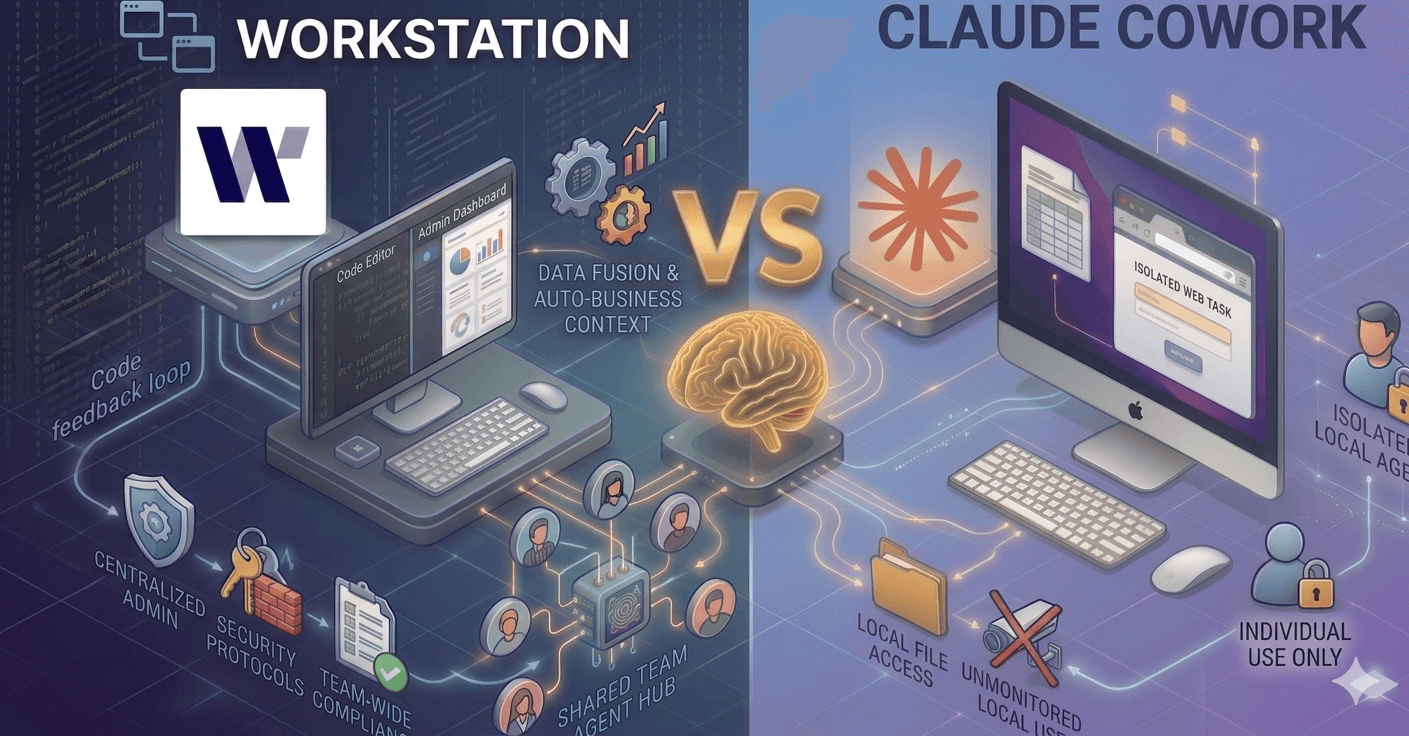
There are a number of products that allow employees to use AI the way they want to use it, while simultaneously protecting the organization's policies and data. Platforms like Workstation give teams the power and speed of state-of-the-art AI tools without the data risks. When data stays local, processed on the employee's machine rather than sent to external servers, there's no reason to hide.
When there's a sanctioned tool that unlocks the creativity and productivity of employees, secrecy becomes unnecessary.
Step 4: Celebrate the wins, not just the warnings
Most internal communication about AI focuses on risks and leaks.
Balance the warnings with celebration. Publicly recognize teams that used AI to ship faster or solve hard problems. Share case studies internally: "Here's how marketing cut campaign prep time in half using structured AI workflows."
Pair programming has been a useful method for software engineering, and there is no substitute for using AI collaboratively in real-time with a team trying to tackle a current business problem.
Make AI fluency a shared value, not a dirty secret. When employees see that using AI well gets celebrated—not punished—they'll stop hiding.
Step 5: Train people to use AI well, not just "safely"
Help employees understand when and how AI adds value. Teach them to recognize when AI is helpful (drafting, research, iteration) versus when human judgment is non-negotiable (final decisions, nuanced strategy, customer relationships). Create shared standards so no one has to guess what "good" looks like.
What It Looks Like When Secrecy Ends
Transparency becomes a competitive advantage
People openly share prompts, workflows, and results. Saying "I used AI for this" is as destigmatized as saying "I used Excel for this."
Your team's collective intelligence compounds instead of fragments. What one person learns, everyone benefits from.
Collaboration accelerates (because no one's hiding anymore)
When AI usage is transparent, employees learn from each other by doing. They are able to take feedback in the middle of AI conversations, and everyone benefits as a result. Best practices spread in days, not months.
Capture easily accessible shared libraries of AI components, skills, assistants, and prompts. New hires ramp faster because the playbook is visible, not tribal. The entire organization gets smarter, faster.
Trust and performance rise together
Employees experiment, share, and improve without fear. Leadership proves that AI is a growth tool, not a threat to jobs or credibility.
And the best people stay because they can do their best work openly, without secrecy or risk.
Your Employees Are Already Using AI
The question isn't whether your team is using AI. They are.
The question is whether they're doing it in the open or in the shadows. If it's the latter, that's because they are seeking the clarity, permission, and tools to bring their knowledge into the light.
Workstation eliminates the need to hide. Give your team a secure, desktop-first AI workspace where they can work openly, collaborate without fear, and build workflows that scale across the organization.
Stop losing productivity to secrecy; nurture a culture where your best people can do their best work openly.
See how Workstation helps teams work openly with AI
FAQ
Q: Is it normal to feel uncomfortable admitting I use AI at work?
Yes—69% of professionals feel that there is social stigma around AI usage. The discomfort usually comes from unclear company policies, fear of judgment, or concern that using AI makes you look "less skilled." The reality: using AI well is a skill in itself.
Q: How do I know if my company has a "pro-AI" or "anti-AI" culture?
Listen to how leadership talks about AI. Do they share their own usage openly? Are employees celebrated for efficiency, or side-eyed for "taking shortcuts"? If you feel like you need to hide your AI usage, that's a signal your culture leans anti-AI.
Q: What should I do if my manager or peers are vocally against AI?
Find allies who are open to AI and share strategies privately. If your company provides sanctioned AI tools, use those—it gives you cover. And if the culture doesn't shift, consider whether you want to stay somewhere that punishes resourcefulness.
Q: How can I use AI at work without feeling like I'm hiding something?
Use approved tools if your company provides them. Be transparent with your manager: "I've been experimenting with AI for [specific task] and it's saving me X hours a week." Frame it as a productivity win, not a confession.
Q: What makes an AI tool "approved" or "sanctioned" for workplace use?
Approved tools typically process data locally (not in the cloud), don't use your inputs for model training, offer role-based access and audit trails, and give your company full control over data. Desktop-first platforms like Workstation are built with these principles.

Workstation
Team


" width="25.9203px"><path d="M 0 0 L 5.94 0 L 10.98 18 L 5.04 18 Z" fill="rgb(10, 1, 79)" height="18.000034px" id="gKlycu6zY" transform="translate(0 0)" width="10.98px"/><path d="M 0 0 L 5.94 0 L 10.98 18 L 5.04 18 Z" fill="rgb(10, 1, 79)" height="18.000034px" id="rbgDUHp_j" transform="translate(10.08 0)" width="10.979999999999997px"/><path d="M 10.98 0 L 5.04 0 L 0 18 L 5.94 18 Z" fill="rgba(10, 1, 79, 0.4)" height="18.000034px" id="rdjjInXYn" transform="translate(5.041 0)" width="10.979989999999999px"/><path d="M 7.884 0 L 5.878 7.2 L 0 7.2 L 1.971 0 Z" fill="rgba(10, 1, 79, 0.4)" height="7.200004px" id="LQCpPwtfH" transform="translate(18.036 0)" width="7.8842px"/></g></svg>)