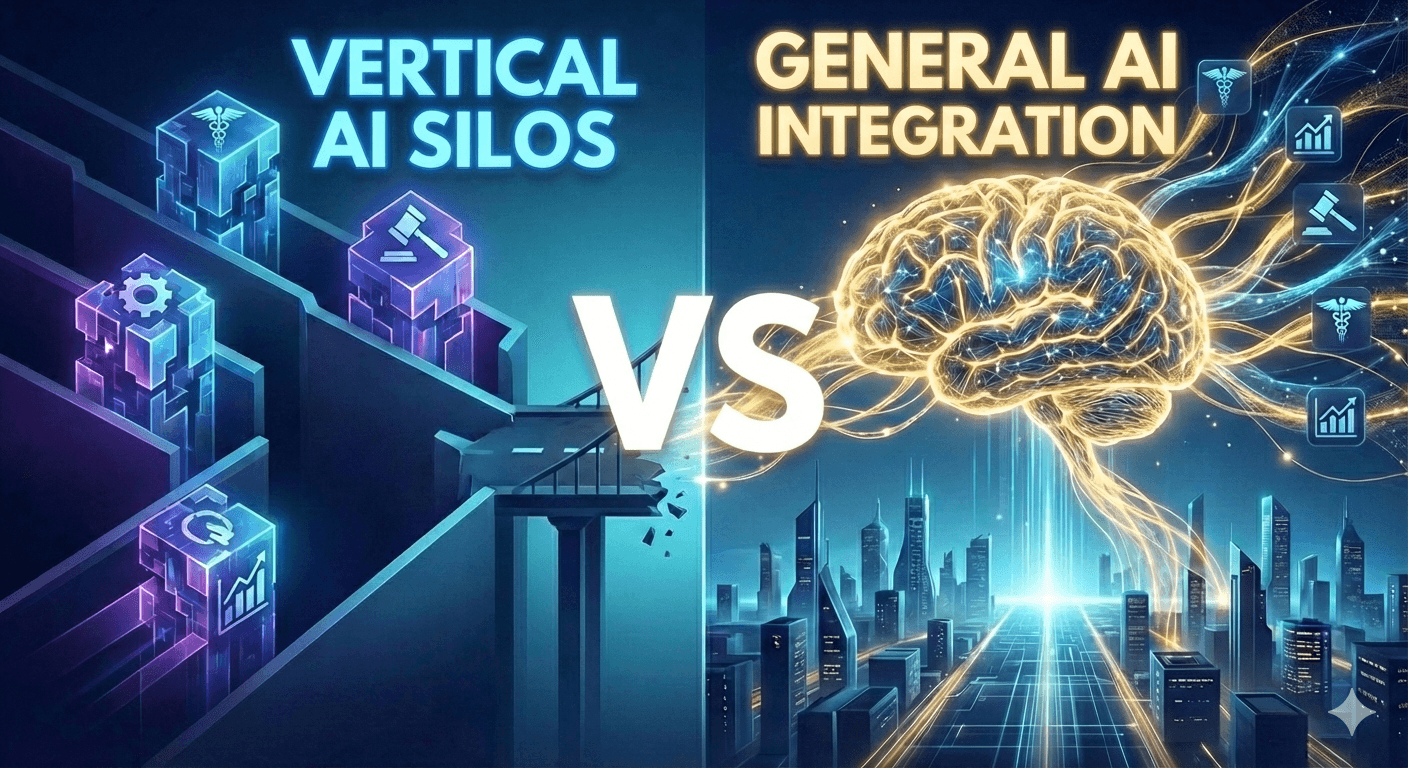
TL;DR
In 2022–2023, the smart money was on vertical AI—specialized AI trained for specific domains
By 2024–2025, general AI models proved they could outperform specific AI models across every human knowledge domain
The problem with vertical AI: fragmentation, rigidity, and inability to handle cross-domain workflows
The future: General AI with context and workflow integration beats narrow specialists every time
In 2023, every company was building "vertical AI" LLMs. Legal AI. Marketing AI. Sales AI. Coding AI.
The consensus was clear: just like SaaS, AI models needed to be fine-tuned and specific to a function. How could a single model be broad enough to understand the nuances of my department, my industry, my workflow? Investors poured billions into the thesis. Startups launched with narrow focus: "AI for insurance claims," "AI for email marketing," "AI for contract review."
It made perfect sense at the time. Specialization wins and domain expertise matters. General tools are surface-level; vertical tools go deep. What we saw in 2025 was the opposite. Those vertical tools were (and are) getting crushed by general AI that's now PhD-level at everything. The vertical AI bet didn't just underperform; it was fundamentally wrong about how AI would evolve.
2022–2023: Why Everyone Bet on Vertical AI
The case for vertical looked bulletproof
When ChatGPT launched in November 2022, it was impressive. It could write, summarize, translate, and answer questions across dozens of domains. But it also felt like a "jack of all trades, master of none."
Ask it to draft a legal memo, and it would give you something plausible but not something you'd file in court. Ask it to write marketing copy, and it would be generic. Ask it to generate code, and it would work broadly, but miss edge cases.
The conclusion many came to was that domain-specific AI trained on specialized data would outperform general models.
This thesis had real examples backing it up:
Harvey raised $80M to build AI specifically for legal work
Medical AI startups promised diagnostic accuracy that general models couldn't match
GitHub Copilot showed that coding assistants trained on billions of lines of code could dramatically outperform general models at writing software
VCs poured billions into vertical AI startups, hoping general AI would become commoditized infrastructure (cheap, undifferentiated) while Vertical AI captures the value (expensive, defensible, high-margin).
What made vertical AI appealing
The appeal wasn't just hype; there were real, logical reasons to believe vertical AI would win:
Domain expertise: Legal AI knows case law, precedent, and jurisdiction-specific rules. Medical AI knows clinical guidelines, drug interactions, and diagnostic criteria. Marketing AI knows your brand voice, audience segments, and campaign history.
Accuracy and trust: Fine-tuned models trained on high-quality domain data could reduce hallucinations in high-stakes environments. If you're diagnosing a patient or filing a motion, "pretty good" isn't good enough.
Workflow integration: Vertical AI could be built directly into the tools people already use. Salesforce AI for CRM. HubSpot AI for marketing automation. Notion AI for docs. No need to change behavior—just add intelligence where people already work.
The prediction was that general AI would become the boring backend (like AWS), while Vertical AI becomes the valuable frontend (like Salesforce). It was a clean, defensible thesis. And for about 18 months, it looked like it was playing out exactly as predicted.
2024: The Cracks Start Showing
The "AI feature" bloat problem
By mid-2024, every SaaS company had rushed to add "AI" to their product. Ironically, the result wasn't productivity; it was chaos.
Suddenly companies had:
Salesforce AI for CRM data
HubSpot AI for marketing data
Slack AI for messages
Notion AI for docs
Asana AI for tasks
Each one was a half-baked assistant helping you navigate its specific app and siloed data, with its own interface, limitations, and context boundaries. The result was fragmentation, not productivity.
You couldn't ask Salesforce AI a question that required HubSpot data. You couldn't ask Notion AI to pull insights from Slack. "AI-powered workflows" were actually five disconnected AI features that didn't talk to each other. Instead of one intelligence layer across your work, companies now had a dozen narrow assistants trapped in their respective silos.
The GPT wrapper trap
At the same time, hundreds of "vertical AI" tools launched. Most of them were just prompts and context layered on top of GPT-4 or Claude.
A perfect example: ChatPRD, a tool designed specifically for creating product requirement documents. It worked well. It was thorough, asked the right questions, structured the output properly, and helped product managers create better PRDs.
But then Claude 3.5 launched with dramatically improved reasoning. Suddenly, you could just ask Claude directly: "Help me write a PRD for [feature]," give it some context, and get the same quality output, or even better.
Suddenly, no one wanted to pay for a wrapper when the general model is doing the same or better.
This pattern repeated across dozens of categories. The "vertical AI" tools that were just thin layers on top of general models started to look unnecessary. The moat wasn't as deep as it seemed.
The cross-domain workflow problem
The biggest crack in the vertical AI thesis was that real work doesn't happen in silos of intelligence.
The Bitter Lesson (a foundational insight from AI researcher Rich Sutton) teaches us that knowledge is porous and continuous. Human expertise doesn't live in neat, isolated buckets. It flows across domains.
Consider a typical business workflow:
Marketing generates leads (HubSpot AI)
Sales qualifies and closes them (Salesforce AI)
Product builds what customers need (Linear AI, Notion AI)
Operations delivers and supports (Zendesk AI, Slack AI)
Each of these steps requires context from the others. But vertical AI forces you to use separate tools, with separate intelligences, that don't share context. You can't ask: "Why are our enterprise leads converting worse than SMB leads, and what should we build to fix it?" because that question spans marketing data, sales data, product data, and customer feedback, and no single vertical AI can see all of it.
The promise of "specialized AI" became the pain of "fragmented AI."
2025: General AI Is Clearly Winning
Why general models are eating verticals
By 2025, the narrative had completely flipped. General AI wasn't just as good as vertical AI tools; it was better across nearly every domain.
Here's what changed:
They got better, fast: GPT-4, Claude 3.5, and OpenAI's o1 reasoning models now outperform domain-specific tools. They can handle specialized tasks (legal analysis, medical reasoning, code generation) at expert levels.
The Bitter Lesson proved true: General methods that scale with compute beat hand-crafted domain solutions. We saw this in chess (Deep Blue → AlphaZero), Go (hand-tuned bots → AlphaGo), image recognition (feature engineering → deep learning), and now language and reasoning.
Reasoning mattered more than fine-tuning: It turns out that broad reasoning ability matters more than narrow training data. A model that can think through first principles can often outperform a model that's been fine-tuned on domain examples but can't reason flexibly.
General models can now handle specialized tasks at levels that would have seemed impossible in 2023. They don't just "know" legal precedent; they can reason about it, synthesize it, and apply it to novel situations.
Real examples of verticals getting obsoleted
ChatPRD vs. Claude: As mentioned above, ChatPRD was a well-built vertical tool for creating product requirement documents. It had structure, guidance, and domain-specific prompts. But once Claude got better at reasoning, it became irrelevant. You could get the same or better output by just asking Claude directly, so the vertical tool added no value.
Claude Computer Use and Manus: In late 2024 and early 2025, Anthropic and other labs demonstrated general AI that can operate across tools, workflows, and data sources. Claude Computer Use can navigate your desktop, use applications, and complete multi-step tasks. Manus (an AI agent platform) can handle end-to-end workflows that span multiple tools and domains.
This is a shot across the bow at hundreds of "personal AI agent" and "workflow automation" startups that built narrow, single-purpose tools. If a general model can navigate your entire desktop and tool stack, interact with any application, and reason across domains, why do you need a narrow agent that only does one thing?
The agentic future favors general AI
The next phase of AI isn't just chat, it's agents. AI that can take action, use tools, and complete complex workflows on your behalf.
But real AI agents need to work across domains, tools, and workflows. A "vertical AI for sales" can't also draft your emails, analyze competitor websites, update your project tracker, and summarize customer feedback. It's locked into its narrow lane.
Agentic AI requires general reasoning and broad tool use, which is exactly what general models provide.
We're just getting started with agents, and the early evidence is clear: the value is accruing to the largest, most capable general models. Not the narrow specialists.
Why Vertical AI Lost (And What We Learned)
The Bitter Lesson: Scale beats specialization
Rich Sutton's "Bitter Lesson" is one of the most important insights in AI history:
"General methods that leverage computation always win over domain-specific approaches in the long run."
We've seen this play out repeatedly:
Chess: Hand-tuned chess engines (domain expertise) lost to AlphaZero (general reinforcement learning)
Go: Expert-designed Go bots lost to AlphaGo (general deep learning + search)
Image recognition: Hand-crafted features lost to convolutional neural networks (general pattern learning)
Language and reasoning: Fine-tuned vertical models are now losing to scaled general models (GPT, Claude, o1)
Vertical AI bet on hand-crafted expertise. General AI bet on scale and reasoning. And once again, scale won.
End-to-end workflows demand general intelligence
Modern work is cross-functional: Marketing informs sales, sales informs product, product informs operations, operations informs marketing.
Vertical tools work middle-to-middle: they handle one step in a process, but they can't see the full picture.
General AI works end-to-end: it can reason across the entire workflow, pulling context from every stage, and connecting insights that vertical tools miss.
You don't want five specialized AIs that each understand 20% of your workflow. You want one intelligence layer that understands 100% of your operation.
Fragmentation is the enemy of productivity
Having "AI features" scattered across 10 SaaS tools doesn't make you more productive. It makes you slower.
Context switching between tools kills the value of AI assistance. You spend more time explaining context to each narrow AI than you save from the automation.
Having one general AI that has access to all your context across all your workflows works a lot better than five assistants that each know a little.
What This Means for How You Work in 2025 and Beyond
For individuals: General AI + your context is the winning formula
Stop using fragmented "AI features" in every app. They're not helping, they're creating friction. Instead, use general AI (GPT, Claude) that can handle end-to-end work at the boundaries of knowledge. Capture and arm AI with your full work context such as documents, data, project history, team knowledge.
The power isn't in narrow specialization. It's in broad reasoning applied to your specific situation. A general model that knows your company, your projects, and your goals will outperform a dozen vertical tools that each know one narrow slice.
For teams: Invest in platforms that bridge general AI and your workflows
Don't buy 20 vertical AI tools that don't talk to each other. You'll end up with fragmentation, not productivity.
Look for platforms that give you general AI power with your data and workflows integrated.
The moat isn't the model, it's the context layer that makes general AI understand your specific work. Platforms that do this well will win, while point solutions that don't will fade.
For decision-makers: The future is general models with secure, integrated context
General AI models are becoming the standard, but the differentiation isn't in the model. It's in how you connect those models to your company's data, processes, and workflows.
Platforms that do this securely without sending your data to the cloud, without training on your inputs, will win. Vertical tools that lock you into narrow use cases will lose.
Why Workstation Is Built for the General AI Future
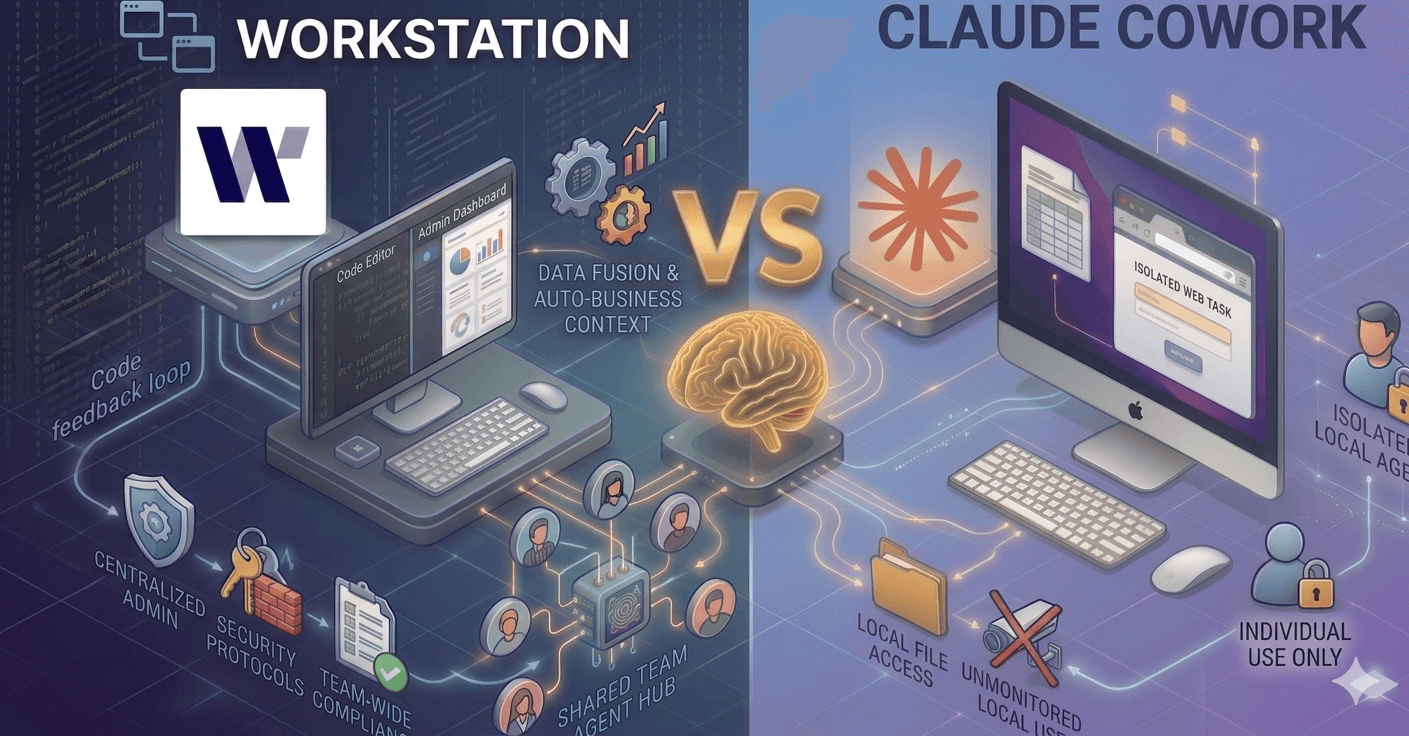
Workstation is not a vertical tool; it is a general AI platform with your context
Workstation gives you access to leading general AI models, including GPT, Claude, and more. But unlike ChatGPT or standalone AI tools, it integrates your data, documents, and workflows.
This context is modular, editable, and portable. You're not locked into rigid templates or narrow use cases. You get the flexibility of general AI with the precision of domain-specific context.
You get general reasoning power applied to your specific context across all your work, not siloed by task.
How Workstation solves what vertical AI couldn't
Cross-functional collaboration: Use one AI to collaborate across marketing, sales, product, ops, no fragmentation. Your intelligence layer spans your entire operation, not just one department.
Your context, always available: Connect your data so AI understands your company, projects, and history. Instead of starting from scratch every time, AI remembers what matters.
Reusable components: Build workflows and templates that encode your processes without locking you into rigid tools. Adapt as your work changes.
Local-first and secure: Your data stays on your machine. No cloud training. No exposure. You get the power of general AI without the risk.
Built for collaboration: Teams share context and workflows, compounding AI's value for everyone. What one person learns, the whole team benefits from.
The result: General AI's power without the fragmentation or risk
You're not locked into narrow use cases or switching between tools.
You're not sending sensitive data to public AI services.
You get the reasoning power of the best general models, applied to your entire operation.
This is what wins in 2025 and beyond.
In Summary: Vertical AI Didn't Work Out, General AI Models Did
In 2022–2023, the consensus was clear: vertical AI would dominate. Specialized tools trained on domain data would outcompete general models.
By 2025, the opposite happened. General AI got so good that narrow specialists became unnecessary. The "GPT wrapper" tools are getting obsoleted. The SaaS "AI features" create fragmentation, not value.
What actually works: General AI models with deep integration into your workflows and data.
Not fragmented assistants trapped in individual apps. Not narrow tools that can't talk to each other. One intelligence layer that understands your full context and operates across your entire work.
Workstation is built for this reality, with general AI reasoning, while keeping your workflows, and data, integrated, collaborative and secure.
[See how Workstation brings general AI into your work →]
FAQ
Q: What's the difference between general AI and vertical AI?
General AI (like ChatGPT or Claude) is trained on broad data and can handle a wide range of tasks. Vertical AI is specialized for specific domains (legal, medical, sales) with focused training data. The debate was whether specialists would outperform generalists. It turns out, general AI won.
Q: Are vertical AI tools just wrappers around ChatGPT?
Many are. They add prompts, context, and UI on top of general models like GPT-4. Some have custom fine-tuning, but most don't offer enough value over using the base model directly—especially as general models keep improving.
Q: Should I use ChatGPT or specialized AI tools for my work?
Use general AI (ChatGPT, Claude) with your full work context. The power isn't in narrow specialization—it's in general reasoning applied to your specific data and workflows. Platforms like Workstation let you do this securely without fragmentation.
Q: What does "general AI with context" actually mean?
It means using powerful general models (GPT, Claude), and giving them access to your documents, data, project history, and workflows. Instead of starting every conversation from scratch, the AI understands your company and work—making it far more useful than a standalone chatbot.
Q: How is Workstation different from using ChatGPT?
Workstation connects general AI models to your workflows and data—locally and securely. You get the reasoning power of ChatGPT and Claude, but with your company context, reusable components, team collaboration, and no cloud exposure. It's general AI built for real work, not just chat.

Workstation
Team


" width="25.9203px"><path d="M 0 0 L 5.94 0 L 10.98 18 L 5.04 18 Z" fill="rgb(10, 1, 79)" height="18.000034px" id="gKlycu6zY" transform="translate(0 0)" width="10.98px"/><path d="M 0 0 L 5.94 0 L 10.98 18 L 5.04 18 Z" fill="rgb(10, 1, 79)" height="18.000034px" id="rbgDUHp_j" transform="translate(10.08 0)" width="10.979999999999997px"/><path d="M 10.98 0 L 5.04 0 L 0 18 L 5.94 18 Z" fill="rgba(10, 1, 79, 0.4)" height="18.000034px" id="rdjjInXYn" transform="translate(5.041 0)" width="10.979989999999999px"/><path d="M 7.884 0 L 5.878 7.2 L 0 7.2 L 1.971 0 Z" fill="rgba(10, 1, 79, 0.4)" height="7.200004px" id="LQCpPwtfH" transform="translate(18.036 0)" width="7.8842px"/></g></svg>)